
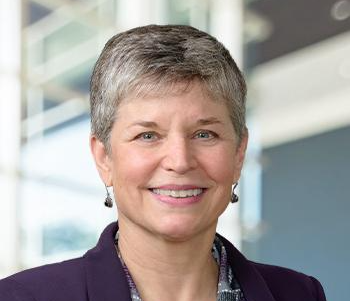
You Will Know Them by Their Love (and Fruits!)
For more than 25 years, Kim Gluck has helped the Foundation invest in a way that matches what it believes. Her test hasn’t changed: would we be proud if people could see what we own?
Kim Gluck has had a rewarding career in the investment business with a series of achievements. But she remembers when she found her people.
It was the 1990s. Gluck was a young portfolio manager at State Street, drawn to an idea most of Wall Street ignored: screen portfolios for social and environmental harm, and use your power as a shareholder to push companies to do better. Few clients wanted it. The ones who did were a group of Catholic nuns, her first ESG clients in 1994, and the United Methodist Foundation of New England, whose portfolio she managed.
“The Methodists and some of the Catholic nuns were the ones who believed in what we were trying to do,” she said. “When you find your people, you stick with your people.”
So, she stuck. After leaving State Street in 2004 and moving to another well-known firm, she went from managing the Foundation’s money to volunteering for it, joining the Investment Committee in spring 2005. Today she co-chairs the committee, whose members bring decades of experience in investment management with firms such as Boston Trust Walden, BlackRock, Travelers, PineBridge Investments, MetLife Investment Management, and in private wealth management.
Built to last, not to dazzle
Gluck brought something rare to the committee. She had done the job at a high level. She knew the Foundation’s model – a modest fee on the money it manages for churches – left little room for expensive managers. Two decades ago, she helped steer it to a low-cost, “custom passive” strategy, well before the rest of the industry moved that way.
The approach is deliberately unassuming. The equity portfolio tracks broad market benchmarks with no big bets, while screening out whole industries to reflect UM values: weapons and guns, for-profit prisons, tobacco, gambling, pornography, and the entire fossil fuel supply chain. The Foundation divested from fossil fuels internationally in 2018 and domestically in 2019.
“We’re not chasing the hot manager who blows up the following year,” she said. “We deliver like the market, without exposure to things that really hurt people.”
The screens haven’t cost churches returns. Some years the Foundation may slightly trail its benchmarks; in others, the screens helped it outperform. Over time, results track closely. Gluck is the first to say it won’t always look brilliant. At every meeting, the committee takes a rigorous approach with our managers and asks the same thing: “What are we missing? What do we have wrong?”
How would Jesus invest?
For Gluck, faith and fiduciary duty pull in the same direction. Years ago, she gave a talk asking how Jesus would invest. Her answer came straight from scripture.
He’d be a screener. “A good tree cannot bear bad fruit,” Jesus says in Matthew. The tree is the company; the fruit is the profit. “Be discerning about the source of the fruit.”
He’d be a fiduciary. In the parable of the talents, the servant who buries his money is scolded, not praised. “There is no lazy money in the portfolio.”
And he’d be an activist. When Jesus found injustice in the temple, he flipped tables. “If Jesus were a shareholder,” Gluck said, “he’d show up at meetings and have something to say.”
“There are no perfect companies, just as there are no perfect people,” she added. “But at the very least, we don’t want to own anything we’d be ashamed of.”
A bigger family
That conviction matters more as the Foundation grows. With the United Methodist Frontier Foundation joining it to form the United Methodist Foundation of the Northeast, Gluck helped write the answers for churches whose money is moving. She wrote them by putting herself in their shoes.
“If somebody called and said, ‘Don’t worry, we’re taking your church’s savings and moving it,’ you’d say, ‘Wait a minute,'” she said. Churches want to know: Can I get my money when I need it? Is the return competitive? Am I taking the right amount of risk? Will it cover my budget? “Those are the things churches lose sleep over.”
Her advice for the new partnership comes from the classroom: “People don’t care what you know until they know that you care.” If a church still brings light to its community, she said, “then this is a step forward in sustaining the mission.”
When you share
Gluck was confirmed at First United Methodist Church in North Andover. She and her husband, Andy, have called Second Church in Newton, a UCC congregation, home since 1990, and raised a daughter and a son there.
One of her friends from middle school would say, “When you share, God gives you more.” Gluck has found it true, including with the Methodists who backed her early. “They did so much to help me grow in my career,” she said. “Every time I have shared with others, I have been the one who truly benefited.”
Elements of this story first appeared in UMFNE’s Generous Living newsletter.